
05 / Chain stage
What is an AI factory?
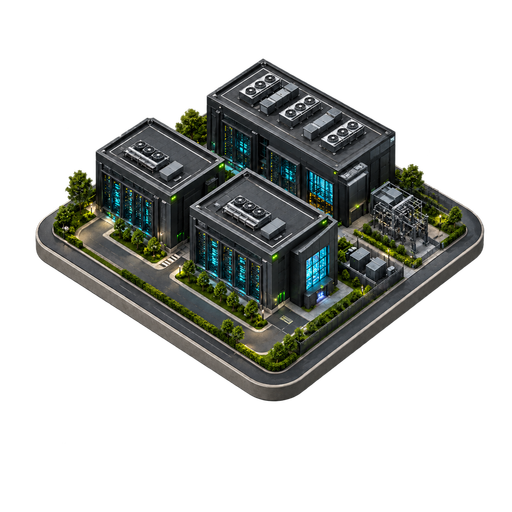
The building itself: secured land and power, halls constructed and energised, cooling installed and the computing equipment racked and commissioned.
(In simple terms: the data centre, from empty field to running machines.)
Why AI needs it
This is where announcements meet physics. Securing a grid connection, getting planning consent, building the halls and energising them are separate gates that each take months or years, and a project can stall at any one of them while still being described as "announced capacity".
How it works
- The operator secures land and a grid connection, which are separate agreements.
- Planning, environmental and regulatory approvals are obtained.
- The shell is built, then power, cooling and network are installed and commissioned.
- Equipment is racked, the fabric is tested, and the hall is handed to a customer.
Inputs and outputs
- Made of
- Land, grid capacity, transformers and switchgear, cooling plant, halls and racks.
- Takes in
- Accelerators, optics, power and years of construction.
- Produces
- Live, cooled, connected compute capacity.
Where it gets stuck
Power is the binding constraint for most projects, and it is a queue rather than a purchase: interconnection studies and utility upgrades run on the grid operator's timetable, not the developer's. Gross utility power is also always larger than the critical IT load it supports, so the headline megawatt figure overstates usable compute.
A general statement about the technology. It is not a claim about any named project — where T2C can evidence a specific delay, it appears in the intelligence ledger with its source.
Where it sits in the chain




Who sells to whom. Operators sell capacity to the companies training and running models.
T2C tracks the delivery end of this chain. An upstream stage is shown as having happened — capacity cannot be billing unless the parts were made — and simultaneously as untracked, because no supplier, order or shipment record sits behind it.
Public companies in this area
T2C holds no sourced supplier record for this component yet.
Glossary
Every term that appears above, defined. Each opens in place.
-
The power that actually reaches the computers.
critical IT load
Power available to IT equipment inside the hall, after conversion, cooling and distribution losses. Always materially smaller than the gross utility figure quoted at the fence, and the reason this site never adds the two.
-
Permission and capacity to connect to the grid.
interconnection
The process of getting a project connected to the electricity network, including studies and any upgrades the connection requires. It runs on the grid operator's timetable rather than the developer's, and it is the most common reason announced capacity slips.
Related signals
- 11 Aug 2026 Contracted power reached approximately 4.2 GW, up from 3.7 GW at quarter end.
- 11 Aug 2026 Active power expanded by nearly 500 MW to reach 1.5 GW.
- 11 Aug 2026 Revenue backlog of approximately $104.2bn as at 30 June 2026.
- 11 Aug 2026 Panther Creek holds 350 MW of contracted firm power with conditional land development approval; environmental permits outstanding.