
02 / Chain stage
What are wafers?
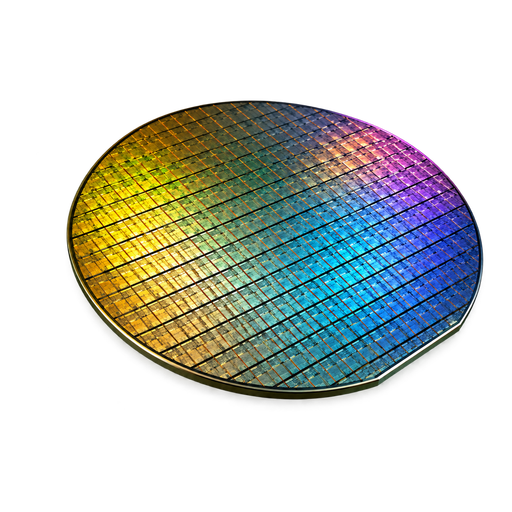
Thin discs of ultra-pure crystalline silicon, onto which the circuits of a processor are printed before the disc is cut into individual chips.
(In simple terms: the discs that chips are printed on and then cut out of.)
Why AI needs it
Every accelerator in an AI cluster begins as a rectangle on a wafer. How many usable rectangles a foundry can print per disc, and how many discs it can start per month, sets a hard ceiling on how many accelerators can exist — one that no amount of demand can lift quickly.
How it works
- A seed crystal is drawn slowly from molten silicon into a single cylindrical ingot.
- The ingot is sliced into wafers and polished to near-atomic flatness.
- A foundry prints circuit layers onto the wafer, one mask at a time, in a cleanroom.
- The finished wafer is tested and cut into individual dies.
Inputs and outputs
- Made of
- Electronic-grade silicon, plus the photoresists, gases and masks used to pattern it.
- Takes in
- Refined silicon and foundry capacity.
- Produces
- Patterned wafers, then individual dies.
Where it gets stuck
Leading-edge foundry capacity is booked years ahead and cannot be added quickly: a new fab is a multi-year, multi-billion project. Allocation, rather than price, decides who gets chips.
A general statement about the technology. It is not a claim about any named project — where T2C can evidence a specific delay, it appears in the intelligence ledger with its source.
Where it sits in the chain



Who sells to whom. Foundries sell fabrication capacity to chip designers.
T2C tracks the delivery end of this chain. An upstream stage is shown as having happened — capacity cannot be billing unless the parts were made — and simultaneously as untracked, because no supplier, order or shipment record sits behind it.
Public companies in this area
T2C holds no sourced supplier record for this component yet.
Related signals
T2C holds no sourced signal for Wafers. The intelligence ledger covers the delivery end of the chain — sites, acceptance and billing — so an upstream stage has nothing on file rather than something thin. Why coverage stops here